
If you haven’t read my previous post, I recommend starting there. It summarizes my journey with Insufficient Glandular Tissue (IGT) and discusses the first stage in the Kübler-Ross model: denial. This post continues my journey with grief and continues on to the second stage: anger.
I would like to recount one specific event shortly after realizing I had IGT. I was sitting in the foyer of our church, bouncing my baby gently on my knee, when a woman I didn’t know approached me. She must have noticed the bottle in my hand, assuming that I could produce milk like any other woman. With a warm but casual tone, she asked, “Do you breastfeed or pump milk for your baby?”
Aghast, I stumbled out awkwardly. “I pump sometimes.” My chest tightened, and I shifted in my seat, hoping she would take the hint and move on. Instead, she continued to tell me how beneficial breastmilk was for babies.
I nodded numbly, barely hearing her words. My mind was already spinning. She doesn’t know. She doesn’t know. I felt a lump form in my throat. The air in the foyer suddenly felt heavier. When she finally left, I sat in stunned silence, clutching my baby a little tighter.
Immediately, I was filled with grief. The grief almost instantly transitioned into anger as I thought about the encounter. She had caught me completely off guard. Who was she to tell me how to feed my son? I replayed that moment in my head over and over and over again, thinking of different ways I could have responded. I wanted to scream that not everyone had normally functioning bodies. To make her aware that her life experiences would not necessarily be like mine. I wanted to scream that I knew the benefits of breastmilk. I knew how good it was for babies. I had done all the research.
But my anger didn’t stop there.
At that moment, I was angry not at this woman but at God. I was angry at myself. I was angry at my body. My body was supposedly designed to create and sustain a new human life. But it couldn’t.
My self-hatred grew and festered in that anger. I hated my life. I hated my body. I couldn’t look in the mirror without feeling broken. What kind of mother can’t feed her own child? The words echoed in my mind relentlessly. I envied women who could breastfeed without a second thought, who never had to track every ounce or triple-check formula ingredients, not to mention the cost of formula. I resented how effortless it all seemed for them while I was stuck fighting against my own biology.
The internal struggles and negativity of self-hatred often don’t remain internal. It leaks into every aspect of life. It affected not only me but also my husband and my son. It drove me into isolation and a spiral of negativity. I withdrew from conversations with friends who were breastfeeding. I avoided baby gatherings where nursing was the norm. I convinced myself that no one could understand, so what was the point of opening up?
It was easy to be in the self-hatred mode of negativity and isolation. More difficult was the path of vulnerability and openness. My husband, like most men, is a problem-solver. He likes to confront problems and fix them all at once. I tend to be more adverse to addressing and solving problems. I am equally averse to confrontation, a trait that has been highlighted in marriage and which I have learned to work on.
Despite my limitations, being vulnerable with my husband was the best choice I could have made. At first, it was difficult. There were nights when I curled up on the couch, too exhausted to speak, and my husband would reach for my hand. I wanted to take it—I needed his strength—but the anger inside me made me pull away. He didn’t understand. He couldn’t. And I didn’t have the words to explain.
But in choosing to be vulnerable and sharing with him my anger toward myself, my perceived inadequacy as a mother, and my self-hatred, we grew closer together. He was able to strengthen me and lift me up when I didn’t have the strength to do so myself. He offered new perspectives and ideas to help me overcome those feelings.
One of the most therapeutic things I did for myself was journaling. Writing helped me work through all the different emotions of IGT. I sometimes would write poetry and share it in Facebook groups for women with IGT. That became a powerful tool to connect with others experiencing the same difficulties I had been feeling. I may share some of that poetry in the future. There was happy and sad poetry. It is all a part of my journey.
In these experiences, my faith has grown to know that we have difficult experiences—hurtful, angry, and negative experiences—so that we may more fully appreciate the joyful moments. But I also learned that anger is a lonely place to live, and I was tired of feeling alone.
I still have moments where I compare my experiences to others and wish that my body did what I had expected it to. However, those times are vastly outweighed by the positive experiences I’ve had being the mama to my little boy. He is full of light, life, and energy, and he loves me—not because of how I fed him but because I am his mother.
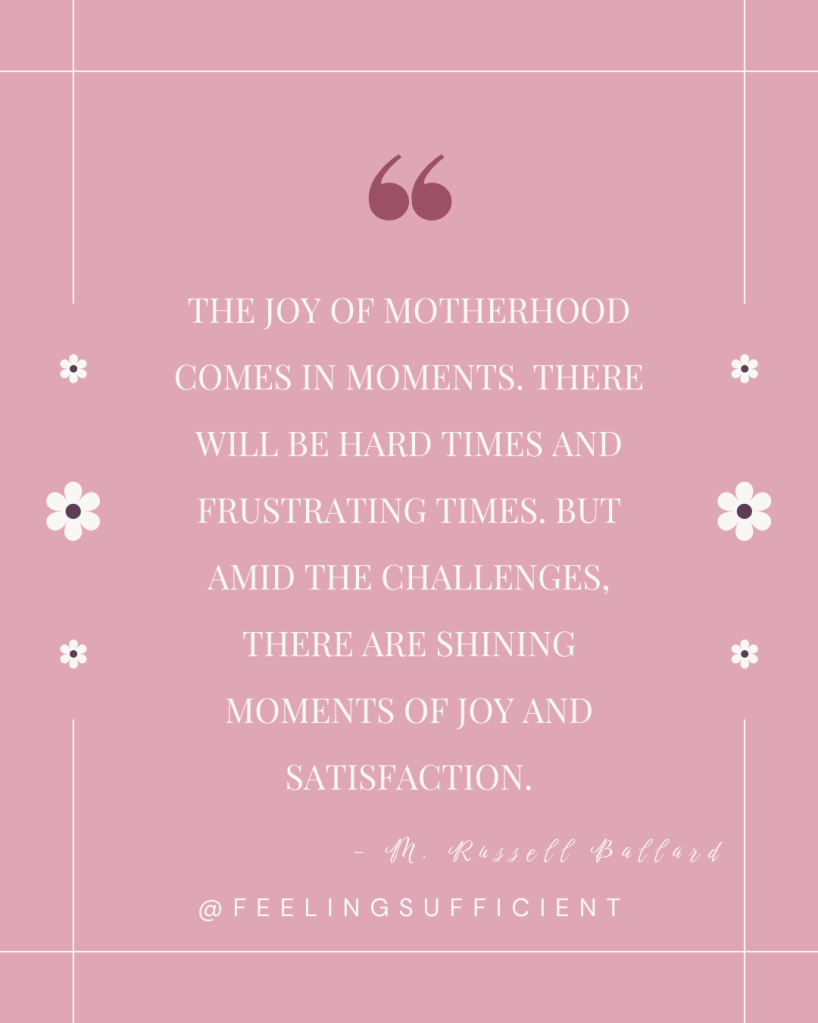
I’d like to share one of my favorite quotes by M. Russell Ballard:
“The joy of motherhood comes in moments. There will be hard times and frustrating times. But amid the challenges are shining moments of joy and satisfaction.”
I have learned that anger is not an ending. It is a turning point. It is the fire that burns away our illusions of control, forcing us to look at what remains. And what remained for me was love—love for my son, love for my husband, and, in time, a growing love for myself.
Motherhood is not defined by a single experience. It is not measured in ounces or feeding methods. It is found in the quiet moments—the sleepy cuddles, the laughter, the outstretched little arms reaching for me. In those moments, I am reminded that I am enough. I have always been enough.
If you are walking this path and feel the weight of grief and anger pressing down on you, I want you to know that you are not alone. The pain will not last forever. There will be light again. And when it comes, even in small, flickering moments, hold on to it.
Because of those shining moments? They are what make this journey worth it.
Please reach out to someone if you are feeling the wight of anger. If you don’t have anyone to reach out to or feel like no one understands, reach out to me and share your story. I would love to read it. Please note, however, that I am not a mental health professional, so I will not be able to counsel. However, I am happy to share resources that can help improve mental health.
Discover more from Feeling Sufficient
Subscribe to get the latest posts sent to your email.

Pingback: Surrendering Expectations: Embracing the Mother I Am Becoming – Feeling Sufficient
Pingback: From Loss to Love: How We Heal and Support Each Other – Feeling Sufficient